A clearer view of your Ski:IQ™
Votes:
Carv has always been built on a strong foundation of metrics to help you understand your skiing. But having a huge list of metrics isn’t always the easiest and most understandable way to review your runs.
Over the years, we’ve worked on different ways of grouping them to make that detail easier to interpret. The challenge has been giving skiers a clear picture of what to work on in each terrain, while making it clear what was driving your Ski:IQ.
This season, we’re keeping the same underlying metrics as last season but introducing one universal way to understand them: Control, Intensity and Line.
These three categories make it easier to understand their Ski:IQ at a glance, see what’s driving your score and identify what to work on next. And most importantly, if you improve one of these components, your IQ will increase.
Which means skiers can start with your Ski:IQ score, identify which CIL factor was your best / worst (helping you understand why you got that score) and explore the metrics beneath each category when you want more detail.
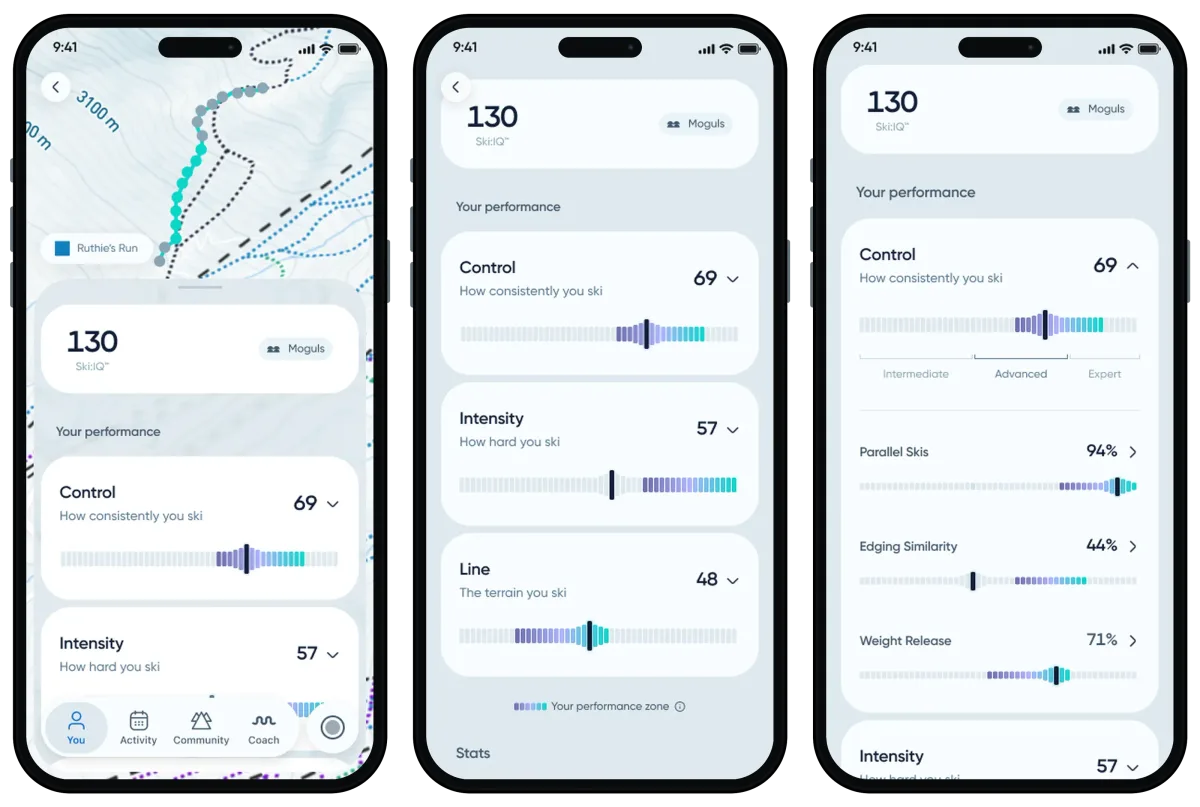
Control brings together the movements that help you make consistent, well-controlled turns. It’s your foundation for skiing more dynamically and taking on more demanding terrain.
In the carving breakdown shown here, it includes:
- Edging Similarity: how closely your two skis match in their edging.
- Parallel Skis: how consistently you keep your skis parallel.
- Turn Shape: how rounded your turns are.
- Edging Smoothness: how smoothly you change your edge angles.
- Weight Release: how effectively you lighten your skis as you transition between turns.
Together, these help you understand the quality and consistency of your movements.
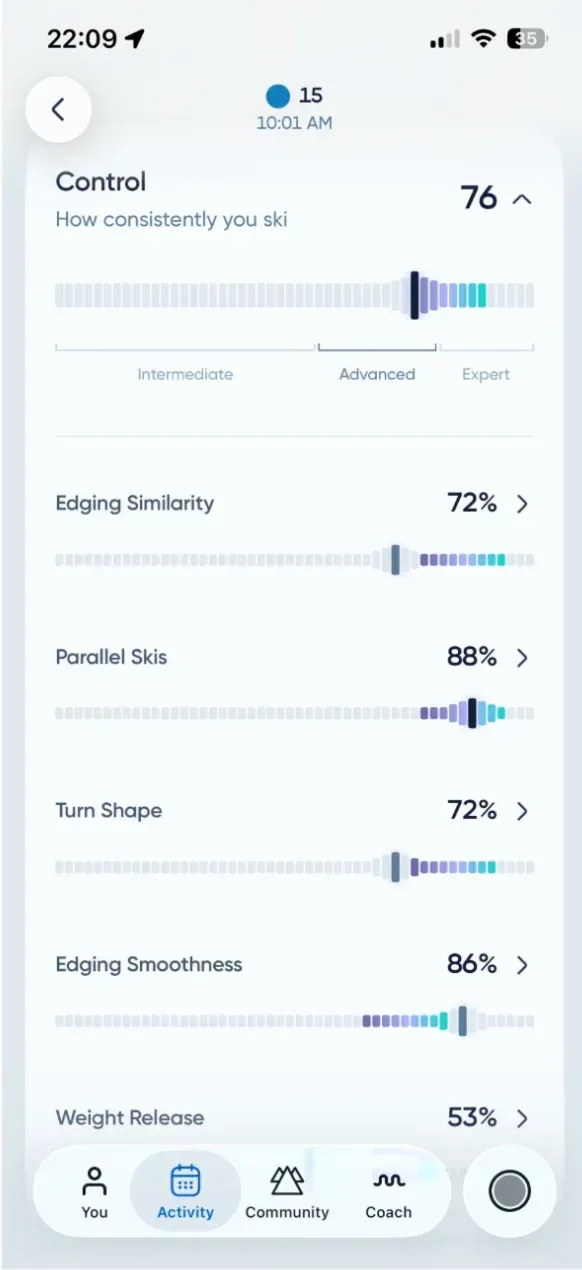
Intensity captures how dynamically you’re skiing. In the carving breakdown, it includes:
- Edge Angle: how far you tip your skis onto their edges.
- G-Force: the forces generated through your turns.
- Early Edging: how early you establish your edges in a turn.
- Edge Build: how progressively you increase your edge angle as the turn develops.
This gives you a picture of how much you’re putting into your turns, and how you develop that intensity.
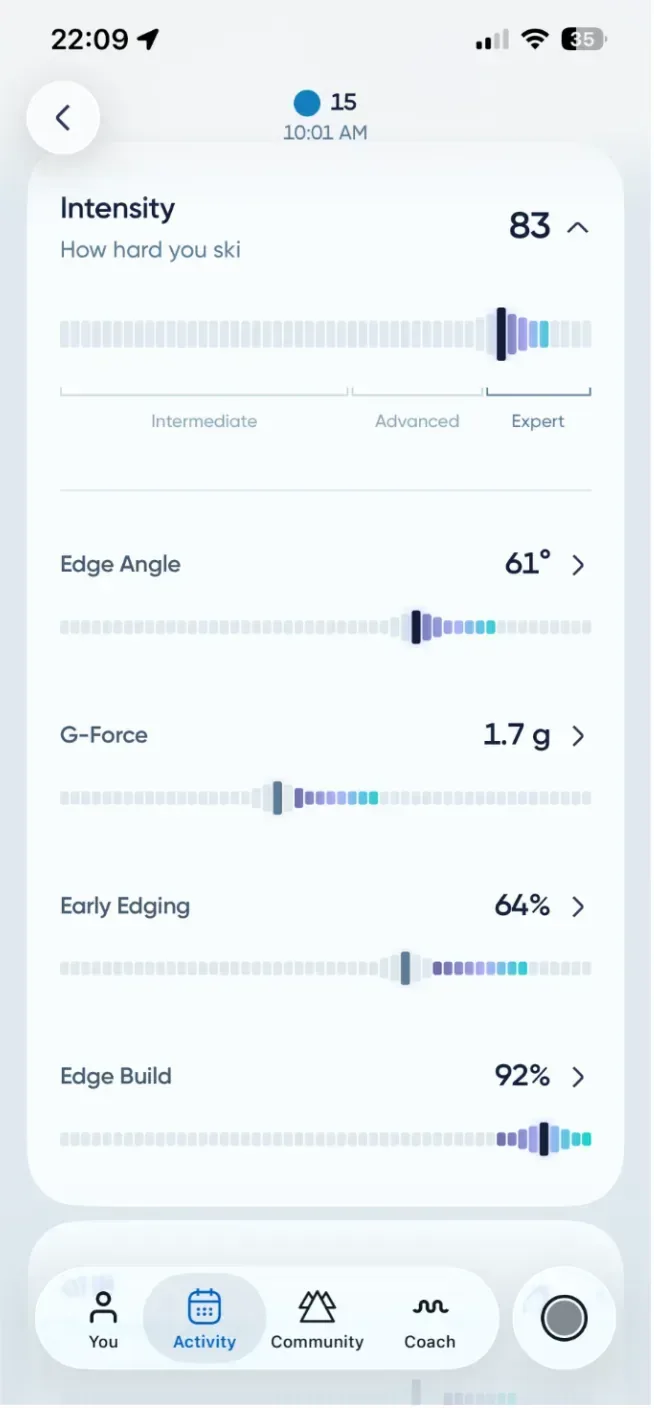
Line reflects both what you ski and how you use the slope. In this carving example, it includes:
- Slope Pitch: how steep the slope is.
- Turn Closure: how far you finish your turns across the slope.
This is why Line is different from a purely technical score: it also recognises the demands of the terrain and the route you take. Across different turn types, the relevant metrics can change, while the three categories stay consistent.
There is no doubt that holding control together, and skiing dynamically on a harder pitch takes more skill - and has been rewarded by the IQ algorithm for a number of seasons now.
This year we wanted to make that clear to see.
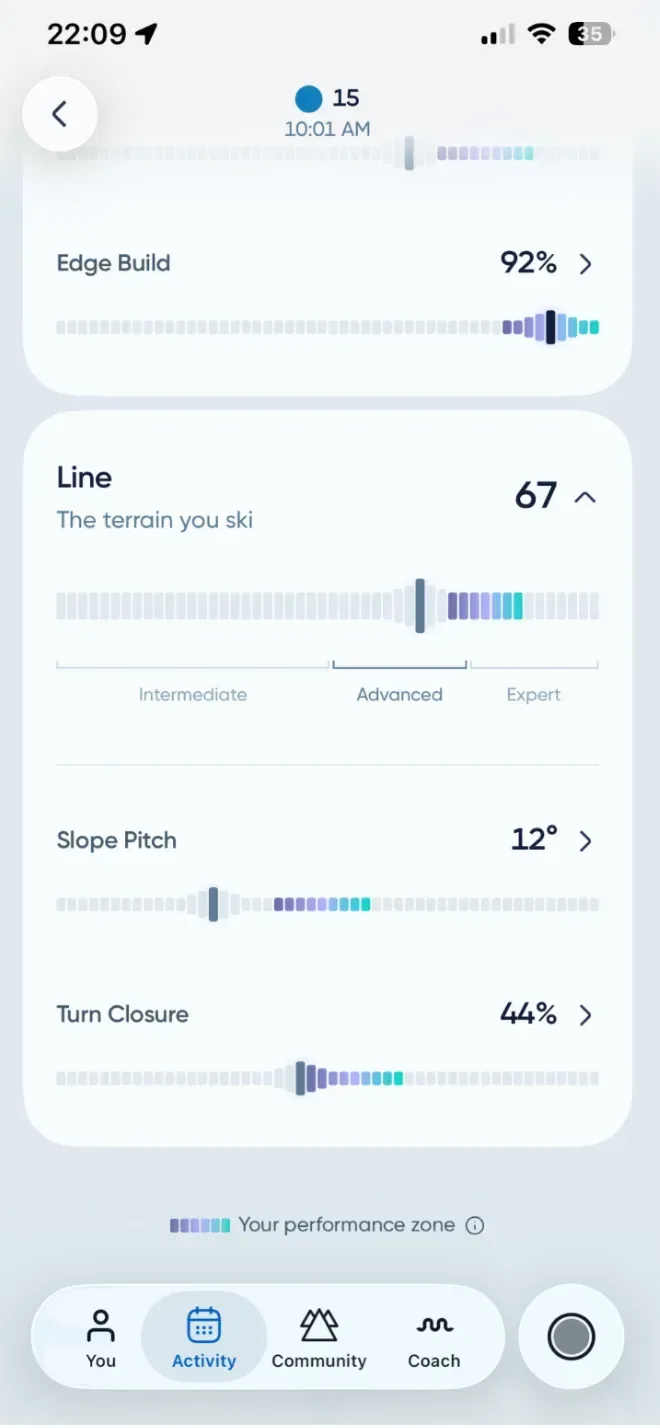
You’ll see the same visual beneath each category and its individual metrics:
- The number is a score out of 100 for each factor, scored against the total popualtion distribution.
- Scoring 100 in control would mean you have one of the top handful of control scores in the entire 1.5bn turn Carv database.
- The coloured zone shows the range that skiers at your level score when they’re skiing well. Your performance zone to aim for.
- The dark bar marks your result for that run.
- The expanded zone around the bar is purely for effect to make the placement of the bar more visible.
If your bar sits inside the coloured zone, that’s a great result - you’re skiing in the performance zone that others at your level achieve when skiing well, and is worth celebrating. The further right you reach within the zone, the better. Surpass your zone and you’re performing better in that category than most at your level.
If your bar falls short, the gap highlights an opportunity. Start with the category showing the biggest shortfall, then expand it to understand which metrics you could work on.
In the example shown, Control is 76 and Intensity is 83, with both bars inside their performance zones. Line is 67, below its zone, making it a useful area to explore. Within Control, Edging Smoothness is already beyond its zone, while Edging Similarity has room to improve. You can recognise your strengths and find your next focus on the same screen.
All three categories contribute to your Ski:IQ. Improve one while keeping the others constant, and your Ski:IQ will rise.
They also interact. Taking on a harder line or pushing your intensity might bring your control down. The aim is to develop your ability to ski more dynamically and tackle more demanding lines while maintaining control.
How does this relate to last year’s skills breakdown?
The skills breakdown offered different ways to break down each turn type - and were another way of grouping the same metrics. However there were 4-6 skills per turn type which meant lots of navigation back and forth to uncover how to improve your IQ. This CIL update gives you one consistent framework across turn types and terrain, making it easier to find your focus whichever terrain and turn type you ski.
Have the underlying metrics changed?
We’re keeping the same underlying metrics. The change is how we organise and present them.
Why don’t I see exactly these metrics on every run?
The examples above show carving. Different turn types use different metrics, grouped under the same three categories. Most of the metrics are shared between turn types.
Are the stats at the bottom part of these groups?
The Stats section separately summarises the run, including turns, distance, top speed, total air, corridor and radius. These stats help describe the turns you did, but CIL helps you narrow down on what drove your Ski:IQ score.
Should I just ski faster or choose a steeper slope?
Choosing a steeper slope is important, but only if you can maintain control and intensity. Often it is better to train on a less steep pitch and then take it to something a bit steeper once you have mastered your control and intensity on a gentler slope. Start with control, then look to work on intensity, then take it to progressively steeper slopes.